

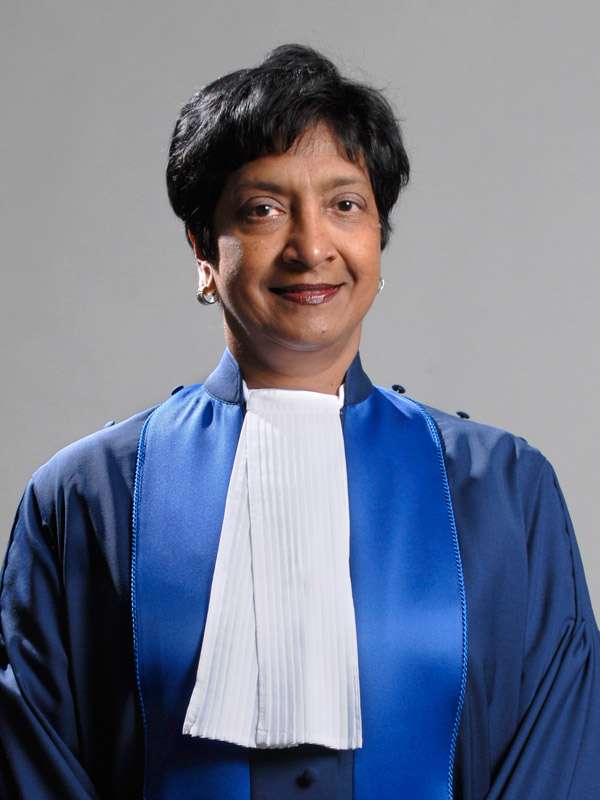
The Norwegian Nobel Committee today announced the award of this year’s Peace Prize to our colleague Navi Pillay, formerly a judge on the ICTR and ICC, ex-UN High Commissioner for Human Rights, former member of the UN commission of inquiry on the OPT and Israel, and currently a judge ad hoc at the ICJ.
It has been a very long time indeed for an international lawyer to be awarded the Prize for his or her legal work – in the early days of the Prize, it was awarded to the Institut de Droit international as a collective body (in 1904) and then to several prominent international lawyers in the first half of the twentieth century, such as Tobias Asser, essentially for their institution-building role. But since Rene Cassin, who was awarded the Prize in 1968 for ‘fathering’ the Universal Declaration of Human Rights, I don’t think that an international lawyer was awarded the Prize primarily for legal work (readers will correct me). Seán MacBride in 1974 is probably the closest for his human rights activism, as is Shirin Ebadi in 2003, but neither was an international lawyer as such (obviously, depending on one’s definition). Mohamed ElBaradei, who was awarded in Prize in 2005, was an international lawyer but he did not get the Prize for legal work.
This year, by contrast, Pillay is honoured precisely for her legal work. In doing so, the Committee honours international law as such, especially in a moment when it and its institutions are under sustained attack. This is explicit in the Committee’s statement, much of which is not about Pillay as a person or her own contribution:
The first Nobel Peace Prize was awarded 125 years ago. Already then, the Norwegian Nobel Committee underscored the importance of resolving conflicts through international law – a theme that has remained prominent throughout the history of the peace prize. The reach of international law expanded after the Second World War, in particular with the creation of the UN institutions. The key insight was that lasting peace must be built on legal principles, not on the will of the strong or a fragile balance of power. Additional legal mechanisms were introduced in the post-war decades, and momentum picked up further after the end of the Cold War.
However, the rules-based international order has never been perfect. The greatest powers have often evaded responsibility. In practice, cases brought under international law have produced different results depending on who is the perpetrator and who is the victim.
Nonetheless, we have seen that more and more conflicts are being addressed through diplomacy, treaties and legal mechanisms, rather than threats, violence and warfare. Leaders and populations alike have come to the same conclusion: international law is a foundation for a more peaceful world.
At a time of existential challenges – including more wars and conflicts than the world has seen in a long time – international law is no longer just a supplement to peace and security. It is an absolute necessity.
And yet, the system of international law is under tremendous pressure, and its institutions are under attack. We see a shift towards power politics at the expense of legal frameworks and global respect for law and justice. Whenever might overtakes right, it undermines stability, trust and peaceful co-existence.
In awarding this year’s Nobel Peace Prize, the Norwegian Nobel Committee wants to remind the world that the rule of law – national and international – underpins the system we have set up to ensure peace and resolve conflicts non-violently. Peace requires justice.
History has shown that a world operating without the rule of law is unjust, unwise and inhumane. The judges – those who guard the thin red line between order and chaos – are therefore highly deserving of our praise. But today, as these same judges are sanctioned, and their institutions are attacked, we need people of courage, vision and determination – qualities that Navi Pillay demonstrates in her work on the bench.
These sentiments will obviously be widely shared in our community of international lawyers, and hopefully others will share them too. There will be some single-issue voters, as it were, who will see the award of the Prize to Pillay as resting (and being justified or unjustified) solely on her views on whether Israel committed genocide in Gaza. I am sure that issue played some role in the Committee’s deliberations. But it is clear from their citation that they are honouring not just Pillay, but international law as a project – a project that is very much relevant to Israel and Palestine, but elsewhere too.
To conclude, here’s a nice clip of Navi Pillay (courtesy of Agnes Callamard) giving a short impromptu speech today at the Palace of Justice in Nuremberg upon being told she received the Prize – as the crowd around her applaud her, she dryly remarks that if they applauded harder she might share her Prize with Trump (we all remember last year’s undignified spectacle).
Amazing moment. Navi Pillay has received the Nobel Peace Prize ! https://t.co/HL3r1PJzLO We are at the Nuremberg Court; I cannot think of a stronger symbol for her Nobel prize. We are all so thrilled! This is her first reactions upon hearing the news: https://t.co/Crbj6XdiyQ
— Agnes Callamard (@AgnesCallamard) October 9, 2026
(Image © ICC-CPI)