

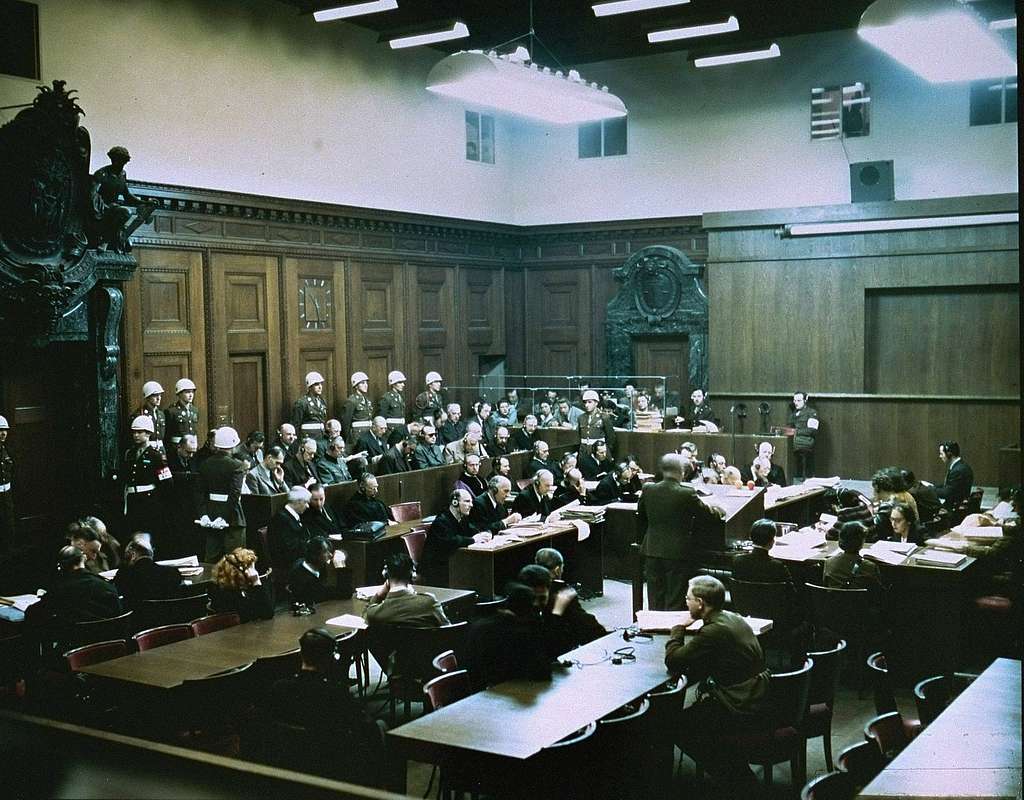
What follow is the 2026 Nuremberg Forum Key Note, as delivered on 7 October at Court Room 600, Nuremberg.
‘If this be an innovation, it is an innovation we are prepared to defend and to justify’
This statement by Britain’s Chief Prosecutor Sir Hartley Shawcross formed an essential part of the Prosecution’s response to the legality challenge submitted Hermann Jahrreiß, a professor from my home university of Cologne, on behalf of the German defence at Nuremberg against the charge of the crime of aggression. Indeed, the Nuremberg charge of crimes against peace – the original name for the crime of aggression – did contain an element of innovation.
After the first World War, Britain and France had fought hard to move forward to ‘un droit international nouveau’, a ‘new international law’ which should include at its core aggression as a crime under international law. Yet, due to Woodrow Wilson’s hesitation and his Secretary of State’s outright rejection, the British and French demand only led to recognition in the Treaty of Versailles that aggression constitutes ‘a supreme offence against international morality’. In 1928, the Kellogg-Briand Pact firmly entrenched a ban on aggressive warfare in international law. Yet, this major advance did not entail the breakthrough toward the international criminalization of such conduct.
This is not to say, however, that the legal evolution in the interwar period had not provided the German aggressors with sufficient prior warning. On the contrary, since the Treaty of Versailles, the international criminalization of aggression was clearly in the air. The 1928 Pan-American Conference, for example, powerfully declared that ‘War of Aggression constitutes an international crime against the human species.’ In 1944, Hersch Lauterpacht, then a rising star of international law, articulated the prevailing sentiment in terms which very much bear repeating today:
The law of any international society worthy of the name must reject with reprobation the view that between nations there can be no aggression calling for punishment.
The ground had thus been prepared to take the ultimate step. And yet, it took the political leaders of the victorious powers until the London Conference of August 1945 to definitively overcome their various hesitations and form the necessary political resolve. This resolve that was then translated into the words of the British Chief Prosecutor which I cited at the beginning.
This fascinating prologue, of which I have just given no more than a sketch, culminated in the Nuremberg Judgment, the 80th anniversary of which we have come together here in the historic Court Room 600 to commemorate tonight. The pronouncement of this historic judgment was a crystallizing moment and the judges did not fail to find memorable words to mark the occasion:
‘To initiate a war of aggression’, they wrote, ‘is the supreme international crime.’
‘If [this law] is to serve a useful purpose…’
But it is also part of the truth that the breakthrough regarding the crime of aggression was an imperfect one – one that came at a significant price. This price was the selectivity of the justice rendered. For there was one State sitting in judgment at Nuremberg that did not come to the proceedings with clean hands. There were ample reasons to extend the charge of crimes against peace to Stalin and his closest collaborators for wars of aggression against Poland, the Baltic States, and Finland. Obviously, doing so was a political impossibility under the circumstances. It is unlikely that this selectivity caused sleepless nights to Stalin. He had developed a taste for show trials at home and his plan was to build on this experience at Nuremberg.
Robert Jackson’s vision, however, was radically different. For him, as Chief Prosecutor of the United States, the international criminalization of wars of aggression was a principle that could not coherently be limited to the defeated Axis powers. And if it was impossible to do justice to this principle in the moment, it was necessary to state it in the clearest possible terms for its full development in the future. For Nuremberg’s leading protagonist, the proper occasion to do so came right at the beginning of the trial. Until today, Jackson’s opening speech has remained one the most memorable moments in the history of justice, which included the following:
the ultimate step in avoiding periodic wars, which are inevitable in a system of international lawlessness, is to make statesmen responsible to law. And let me make clear that while this law is first applied against German aggressors, the law includes, and if it is to serve a useful purpose it must condemn aggression by any other nations, including those which sit here now in judgment.
The power of this statement is owed not only to its elegance, but to the two lasting truths it embodies. First, the ultimate purpose of the international criminalization of aggression is the prevention of its occurrence. If aggression does occur, apart from and beyond providing the victims with justice, the punishment of those State leaders responsible for it serves the goal of protecting the prohibition of aggression from eroding. To achieve this purpose, the international criminal sanction for aggression must, second, be enforced in a manner which is legitimate — and one essential ingredient of legitimacy is the credible attempt to treat all concerned equally.
‘Aggression belongs to, but is hanging by a thread in the firmament of international offences’
As we gather today, it is fair to say that, despite all remaining deficits, very significant advances have been made toward a less selective adjudication of genocide, crimes against humanity, and war crimes. But Robert Jackson’s shining Nuremberg promise regarding the crime of aggression has remained unfulfilled. In fact, Nuremberg’s landmark precedent on the crime of aggression, after having been endorsed by the UN General Assembly, confirmed at Tokyo, and restated by the International Law Commission, was marginalized for more than seven decades.
One important reason for this state of affairs has been the problem of definition. Nuremberg had established aggression as an international crime, but it had not solved the question of its definition. The problem of definition was not fully solved, either, by the UN Charter and one of its cornerstones, the prohibition of the use of force. For this prohibition soon turned out to be surrounded by a significant grey area of genuine legal uncertainty, reflective of certain deep-seated policy differences among States. This made it a real challenge to generalize the Nuremberg precedent on the crime of aggression. The challenge had been foreshadowed as early as 1927 by Britain’s Foreign Minister Austen Chamberlain. His concern that a definition of aggression could become ‘a trap to the innocent’ has since become notorious.
But this concern was certainly not the only reason for the long period of the crime of aggression’s marginalization. Another was what Gerry Simpson has aptly called ‘sovereigntist resistance’. Benjamin B. Ferencz, the most authoritative and charismatic ambassador of the Nuremberg legacy on the crime of aggression, described the sovereigntist mindset in the following way:
The vital ingredient that was really lacking was the political will of a few major powers that persisted in their refusal to accept rational international controls over the use of military force.
Importantly, and this is yet another reason, those ‘few majors powers’ were not really challenged by the holders of soft power; in particular not by leading international Human Rights Organizations, such as Amnesty International or Human Rights Watch. For those organizations, aggression was not a violation of human rights, but conduct directed against State sovereignty. And the protection of State sovereignty was viewed by those same organizations as potentially conflicting with that of human rights.
Two quite different currents therefore converged: powerful states resisted external legal control over their resort to force, and the emerging human-rights centred international criminal justice movement concentrated overwhelmingly on genocide, crimes against humanity, and war crimes.
Together, this helped to cement the marginalization of the crime of aggression for many years to come. The term ‘Atrocity Crime’ became the catch-word for this alliance. The holders of soft power declared the need to fight against the impunity of atrocity crimes, to the exclusion of the allegedly non-atrocious crime of aggression. The military powers of the West happily embraced this rhetoric.
In three dramatic diplomatic nights since the vibrant renaissance of international criminal justice in the 1990s, the marginalization of the crime of aggression became visible as if under a magnifying glass. On the night of 17 to 18 July 1998, in Rome, the crime of aggression only barely made it into the jurisdiction of the first permanent international criminal court in legal history, the ICC – thanks only to the insistence of Non-Aligned States and a few other States such as Germany and Italy. In the night of 11 to 12 June 2010, in Kampala, the crime of aggression – thanks, in particular to Liechtenstein’s skilful diplomatic persistence – was eventually defined, but the Court’s exercise of jurisdiction over the so defined crime became subject to distinct and debilitating restraints. Finally, in the night of 14 to 15 December 2017, in New York, the exercise of jurisdiction over the crime of aggression was activated as of 17 July 2018. But Britain and France, in particular, had been playing hard ball to amend the Kampala amendments in order to tighten the limitations on the exercise of jurisdiction over the crime of aggression even further. The drama had peaked when – following a French demand – the almost incredible possibility loomed large in the evening conference room at UN Headquarters that the century-long journey towards providing for a permanent international criminal jurisdiction over the crime of aggression would ultimately derail over the question of whether a few words should be placed either in a preambular or an operative paragraph.
In a particularly illuminating reflection, Frédéric Mégret characterized the situation of the crime of aggression at the time as follows:
aggression belongs to, but is hanging by a thread in the firmament of international offences.
On 25 February 2022, the then Prosecutor of the ICC made the accuracy of Mégret’s metaphor plain to the world.
One day before, President Putin had initiated Russia’s full-fledged war of aggression against Ukraine. When the world was still in shock, the Prosecutor of the ICC stated dryly:
My office has […] received multiple queries on the amendments of the Rome Statute with respect to the crime of aggression [….]. Given that neither Ukraine nor the Russian Federation are State Parties to the Rome Statute, the Court cannot exercise jurisdiction over this alleged crime in this situation.
‘Why not create a dedicated international tribunal to investigate Putin and his acolytes for the crime of aggression?’
To this correct, but frustrating message, Philippe Sands responded three days later in the Financial Times with the above question. His call of 28 February 2022 marks the beginning of the end of the marginalization of the crime of aggression. The remarkable development since then is probably best explained by the coincidence of a Nuremberg-like sense of urgency and a healthy re-appraisal of the true nature of the crime of aggression. To be clear, Russia’s ongoing war of aggression against Ukraine is not the first war of aggression since 1945 warranting the institution of criminal proceedings. But Russia’s full-scale invasion made it impossible to maintain that aggression is essentially a matter of the past.
As to the true nature of the crime of aggression, the UN Human Rights Committee had already in 2018 paved the way for moving beyond the unduly narrow understanding that State sovereignty was the only protected value at stake. In its General Comment 36 on the right to life the Committee had stated:
State Parties engaged in acts of aggression as defined in international law resulting in deprivation of life, violate ipso facto article 6 [that is the right to life] of the covenant.
Thereby, the Human Rights Committee has claimed a space for the human rights conscience to address by its own distinct normative voice all the war violence inflicted by an aggressor State. The Committee’s ground-breaking move was barely noticed at the time. But in the wake of Russia’s full-scale war of aggression against Ukraine, this space got occupied. Unsurprisingly, the Ukrainians were the first to lament the fact that the hands of the Prosecutor of the ICC are tied specifically with respect to the crime of aggression because of the distinct jurisdictional restraints in the ICC Statute. And it is telling that President Zelensky has been so emphatically joined in his call for prosecuting President Putin and other Russian leaders for crimes of aggression by Oleksandra Matwijtschuk, whose Center for Civil Liberties was awarded the Nobel Peace Prize in 2022.
The call of the Ukrainians soon turned into an outcry of the world’s conscience in a way that has, again and again, at historic junctures, shaped the evolution of international law. Parliamentarian Assemblies took the lead, most notably Parliamentarians for Global Action. After a little while, many governments followed. States from Central and Eastern Europe have been playing a particularly important role: Poland, the Baltic States, and also Finland retain a vivid memory of the painful blind spot in Nuremberg’s legacy on crimes against peace and how this has helped Putin glorify the imperialist Soviet past.
Today, this powerful new momentum regarding the crime of aggression has moved us remarkably close to the establishment of the Special Tribunal for the Crime of Aggression against Ukraine – with Britain and France also having jumped on the train. The basic legal framework for the Tribunal is in place. This is remarkable given that the policy preferences regarding the Tribunal’s design had been so divergent that they long seemed insurmountable. New York University professor Jennifer Trahan has just told the story of the negotiations in book form. I wish to pay tribute to Ukraine’s chief negotiator Ambassador Anton Korynevych, who honours us with his presence today, and to the splendid legal team at the Council of Europe under whose auspices a genuine compromise was worked out. Ambassador Korynevvych, it is fully deserving that your enduring leadership has recently been recognized by the Robert H. Jackson Center through the Joshua Heintz Award for Humanitarian Achievement.
This historic venue is the proper place to first appeal to my own country to complete, as soon as possible, the parliamentary process necessary for its final commitment to the Special Tribunal’s coming into existence. In view of its own heinous aggressive past, Germany has rightly assumed, since the lead-up to the Rome conference, a particular responsibility with respect to ensuring international accountability for future crimes of aggression. This responsibility should now include providing the necessary budgetary support for the conduct of the first international criminal proceedings for the crime of aggression since Nuremberg and Tokyo.
I also wish to appeal to States all over the world to join the relevant Enlarged Partial Agreement. While this agreement was set up under the auspices of the Council of Europe, it is open for acceptance also to non-European States – as Australia’s and Costa Rica’s engagement show. I am fully aware that this appeal entails the need to answer an important question, one that we have already encountered, that of selectivity. In my view, an exercise of jurisdiction through the Special Tribunal for the Crime of Aggression against Ukraine can be defended as an instance of necessary selective justice, much in the same way as the selectivity of the foundational precedent at Nuremberg could be defended under the then prevailing circumstances.
But – and this is a crucial but – the caveat that Robert Jackson expressed in his opening speech about 80 years ago in this room applies with equal force with respect to the Special Tribunal. If this Tribunal, apart from providing badly needed justice for Ukrainian victims, is to serve the ultimate purpose of avoiding periodic wars, which are inevitable in a system of international lawlessness, it must be an instrument of transition, a stepping stone towards a genuine embrace of Nuremberg’s promise through a more principled jurisdictional regime in the ICC Statute.
‘The Assembly of States Parties … commits itself to the aim of strengthening the [International Criminal] Court’s jurisdiction over the crime of aggression’
It is very encouraging that the large majority of the supporters of the Special Tribunal – including, importantly, Ukraine – share this view. They soon started an initiative to align the ICC’s jurisdiction regime for the crime of aggression with that for genocide, crimes against humanity, and war crimes. Last year, Costa Rica, Germany, Sierra Leone, Slovenia, and Vanuatu tabled a text proposal in that regard and the Assembly of States Parties convened for a Special Session with this sole point on the agenda. While they did not yet adopt the proposal, on 9 July 2025, the States Parties to the ICC committed themselves, by consensus, to the aim of ‘strengthening the Court’s jurisdiction over the crime of aggression.’
In the meantime, the relevant diplomatic process has begun with a view to bringing the mission to completion in 2029. Three years from now seems a long time, but experienced diplomats know well that the time for decision is actually almost around the corner. My second appeal today is therefore to all States Parties to the ICC to resolve together to meet their 2025 New York commitment. I make this appeal in full awareness of the fact that international criminal justice is currently sailing in rough waters.
In particular, the government of the United States has not only abandoned its great Nuremberg legacy on crimes against peace, it has even chosen to threaten those who are striving to bring this legacy to its full fruition. My appeal is to meet the additional test to which the current US administration puts the political resolve of the States Parties – and to do what is right despite the threat. The reasons for the now openly declared goal of the United States to dismantle the ICC go very far beyond the question of the crime of aggression. The States Parties to the ICC Statute can therefore not appease the US administration by abandoning their aim to strengthen the Court’s jurisdictional regime over that crime. Crucially, appeasement must not be the answer where the question goes to the most important currency of international criminal justice: its legitimacy.
In the case at hand, the question of legitimacy concerns the ICC’s legal framework. There is simply no convincing reason of principle that would justify the existing distinct limitations on the Court’s exercise of jurisdiction over the crime of aggression. Therefore, those limitations constitute a double standard which, as long as it exists, will adversely affect the ICC’s overall legitimacy. That a sense of double standards may lead to disaffection is more than the theoretical speculation of an academic observer. In fact, many African, Asian, and Latin American States have yet to develop a full sense of their co-ownership with respect to the Kampala amendments. This possibility was gently alluded to by South Africa’s Kampala delegate André Stemmet who stated as follows:
The major weakness is, of course, that Non-State Parties […] will be able to commit aggression with a sense of impunity, and this reflection of realpolitik may result in a very slow process of ratification and acceptance.
Apart from legitimacy, there is the urgency of the hour. The recent posture of the US administration with respect to the prohibition of the use of force signifies a descent from unlawfulness to lawlessness. This posture is contagious. It has made the risk of ‘an international system of lawlessness’ in which ‘periodic wars are inevitable’ more acute than at any point since 1945. It is high time to move beyond a number of often repeated objections which have been refuted for so long.
No need to repeat that the distinction between atrocity crimes and the allegedly non-atrocious crime of aggression is fallacious. Also, it should by now be abundantly clear that the fact that the crime of aggression presupposes a wrongful State conduct and that it constitutes a leadership crime, does not make it uniquely ‘political’ in any sense that warrants a weaker jurisdictional regime. International criminal courts, including the ICC, usually focus on those persons who are (allegedly) most responsible for the commission of crimes under international law. Quite often, these persons are present or former State leaders, as is the case with Mr Al-Bashir, Mr Putin, Mr Netanyahu, and Mr Duterte. That all those proceedings, none of which is for the crime of aggression, are of the highest political sensitivity is difficult to deny.
Finally, it would be very odd indeed if Britain and France returned to the so often disproven argument that accountability for aggression required the green light of the UN Security Council. The legal framework underpinning the Special Tribunal for the Crime of Aggression Against Ukraine, which both States support, is irreconcilable with such a premise. In fact, it is being designed precisely because Security Council authorization is unavailable.
Putting to rest the fear of ‘a trap for the innocent’
Instead of wasting any more time with objections of such an obviously feeble nature, the seriousness of the hour calls for an honest engagement from all sides with what is genuinely of concern to the sceptics. This brings me back to the worry which Chamberlain so famously expressed almost exactly a century ago. In contemporary terms, the concern is that the exercise of the Court’s jurisdiction over the crime of aggression could become a ‘trap for the innocent’.
The legal context of this concern has very significantly changed since June 2010, which marks a true watershed moment in the evolution of the law against aggression. Here, States adopted for the first time in history a definition of the crime of aggression. I said ‘States’ instead of States Parties to the ICC Statute. This was no slip of the tongue. For the definition of the crime of aggression, which is enshrined in Article 8 bis of the ICC Statute, embodies more than a consensus among States Parties. It constitutes the result of decade-long negotiations in which non-State Parties took an active and influential part – precisely as it should be in case of a definition which is destined to be applied universally and which must therefore reflect general customary international law. Zhou Lulu, a delegate from China, made the point when she wrote:
the threshold clause reflects customary international law and distinguishes appropriately between illegal international acts and international crimes.
It certainly also deserves recalling that Russia’s Kampala delegates Gennady Kuzmin and Igor Panin stated thereafter that
Russia is satisfied with the outcome of the Review Conference with regard to the definition of the crime of aggression.
In view of this, the core group of States that drafted the Statute for the Special Tribunal had every reason on their side to choose this definition for application by the Tribunal. In doing so, they have further consolidated the authority of this definition.
Obviously, such an international consensus definition could only be a modest one. This modesty is encapsulated in the so-called threshold clause which constitutes the crucial part of the formulation of the State conduct element of the crime. This threshold clause requires an act of aggression by a State which, by its character, gravity, and scale, constitutes a manifest violation of the Charter of the United Nations. As its wording makes clear and as the travaux préparatoires confirm, this threshold requirement implies a quantitative and a qualitative dimension. These two dimensions taken together enable the prosecutor and the judges of the ICC to interpret Article 8 bis in conformity with customary international law.
Quantitatively, it requires an unlawful use of force on a significant scale, reaching at least the level of what has been described in the literature as a limited war in the material sense. Perhaps even more importantly, through its qualitative dimension, the threshold reflects the important fact that had posed a formidable obstacle to agreeing on a definition for so long. The fact that the prohibition of the use of force is surrounded by a grey area of genuine legal uncertainty which is reflective of deep-seated policy differences among States.
Accordingly, anticipatory self-defence in case of an imminent armed attack, self-defence in case of a cross-border armed attack by non-State actors, or the forcible rescue of nationals abroad in dire need do not currently fulfil the State conduct element of the crime of aggression. The same is true for so-called humanitarian intervention undertaken as a last resort to alleviate extreme humanitarian distress on a large scale if action in the Security Council is blocked: such military action is widely considered contrary to the prohibition of the use of force even if conducted under such stringent conditions. However, especially in view of by now numerous instances of State practice, this position is no longer beyond question. Accordingly, the negotiations leading to the adoption of Article 8 bis of the ICC Statute have confirmed that customary international law has not evolved up to a point that would justify the conclusion that a genuine humanitarian intervention comes within the State conduct element of the crime of aggression.
An honest engagement with Chamberlain’s century-old concern should begin with duly considering this modesty of the international consensus definition of the crime of aggression. This modesty, I submit, precludes a genuine worry that this definition, properly applied in conformity with customary international law, constitutes ‘a trap for the innocent’. Honesty requires, however, to accept that the same modesty does not preclude a different worry: that concern is that a future prosecutor and the relevant majority of future judges of the ICC might construe the definition of the crime of aggression more broadly than they should. This, I submit, is today’s version of the old worry of defining aggression resulting in ‘a trap for the innocent’.
Take genuine humanitarian intervention, which is probably the most sensitive current controversy surrounding the prohibition of the use of force: Australia, Britain, Canada, France, and New Zealand have repeatedly asked between the lines of their various interventions what guarantees that a future prosecutor and the relevant majority of future judges of the ICC will not open an investigation into our political and military leadership in case of their future involvement in a genuine humanitarian intervention? Who, they wonder, gives us the assurance that the ICC will not water down the threshold clause in Article 8 bis to give the definition of the crime of aggression a more expansive meaning? The honest answer to these questions is that nobody can give such an assurance. This is all the more so as the words ‘manifest violation by its character, gravity and scale’ are abstract terms, in obvious need of interpretation.
Yet, honesty on the side of the sceptics would require acceptance that a future prosecutor and future judges of the ICC will not be the first to interpret the threshold clause of the definition of the crime of aggression. Instead, those official interpreters could – and no doubt would – turn to the existing scholarly literature on the subject and when doing so, they would see that there is widespread agreement that the threshold clause must be narrowly construed to the exclusion, also, of genuine humanitarian intervention. Furthermore, a future prosecutor and future judges will be acutely aware of the fact that the international consensus which underpins the definition of the crime of aggression depends on the stringency of this definition’s threshold clause not being watered down. It can therefore be stated with confidence that the risk of ill-guided judicial activism in the interpretation and application of the threshold clause is very limited.
But even if the sceptics genuinely consider this very limited risk to be intolerable, there still remain ways to address their concern. Let me name three. It is not common that a prosecutor has given some advance indication as to a point of interpretation and a future prosecutor could certainly do something similar with respect to the threshold clause of the crime of aggression. States Parties could also consider adding another procedural safeguard to the applicable legal framework. This should take the form of a specific Rule of Procedure and Evidence, providing for the voting requirement of a qualified majority within the Pre-Trial Division when the latter is called upon to grant a request by the Prosecutor for authorization of an investigation. A further safeguard could be the provision of yet more guidance concerning the stringency of the threshold requirement by adding one more interpretive understanding to the definition. The relevant formulation would no doubt require great care and sophistication, but there is no reason to fear that negotiators could not deploy their diplomatic ingenuity one more time.
‘… the law … must condemn aggression by any … nation, including those which sit here now in judgment’
This brings me to my conclusion. The foundational precedent of the crime of aggression, as set in this room almost exactly 80 years ago, was premised on the broader – and shining – promise of a principled and meaningful prosecution and adjudication of the crime of aggression in the future. As we gather today, the international legal order is in serious trouble and Robert Jackson’s warning of ‘periodic wars’ is of acute relevance. This makes it a matter of the utmost urgency that Nuremberg’s legacy against aggressive warfare be fully embraced in the near future.
Last year, States Parties made a very significant move in this direction: they committed themselves to strengthen the jurisdiction of the ICC over the crime of aggression by 2029. This commitment implies the abandonment of a mindset of sovereigntist resistance. One genuine concern, however, appears to remain: the concern that the ICC’s exercise of jurisdiction over the crime of aggression could turn out to be ‘a trap for the innocent’ as a result of judicial activism. But this concern can be addressed. It can be addressed without calling into question the 2010 landmark achievement of arriving at an international consensus definition of the crime of aggression. It can be addressed through an honest engagement with the remaining sceptics aimed at providing persuasive assurances that this definition will be applied narrowly, in strict adherence to general customary international law.
If this path is chosen, it is my sincere conviction, based on almost thirty years of active involvement in the negotiations, that Nuremberg’s shining promise of a principled and meaningful prosecution and adjudication of the crime of aggression can be fulfilled in 2029. And this by consensus instead of a vote. What a tremendous step this would be! A most powerful reassertion of multilateralism in defense of a world order based on international law!