

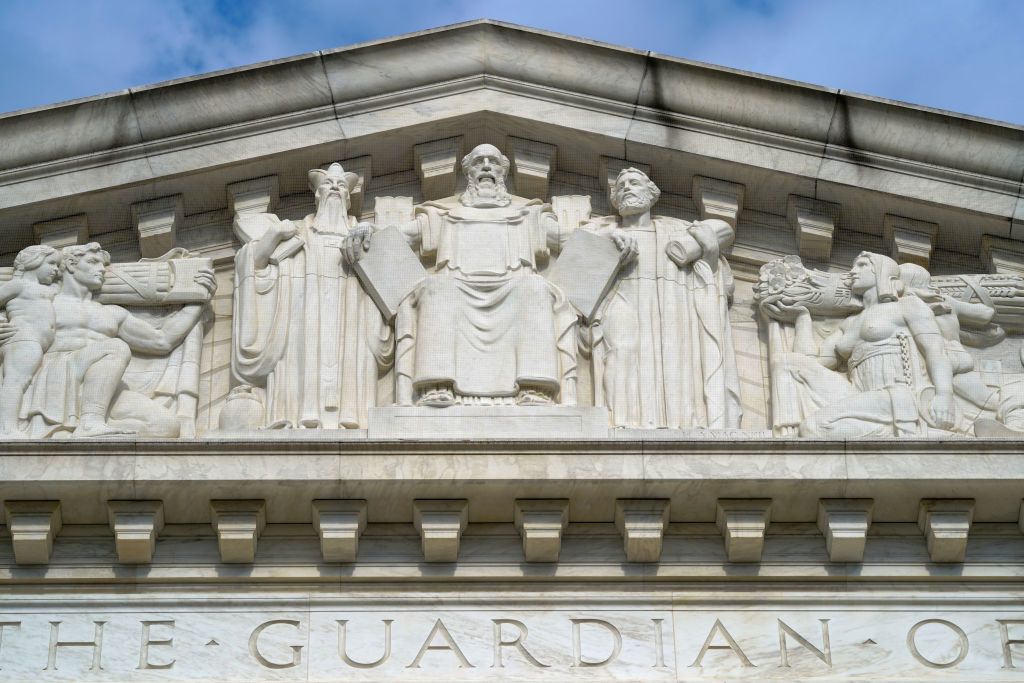
As the back-to-school spirit sweeps across the nation, education is likely on the minds of the Supreme Court justices (especially those with kids still at home or in college). The court is preparing for a term that will involve at least one major dispute on religion in schools – and potentially more.
Already, the justices have agreed to hear a Catholic preschool’s challenge to the policies governing Colorado’s universal preschool program, and many court watchers expect them to also review state laws requiring Ten Commandments posters to be hung in public-school classrooms. Two petitions challenging such laws were filed in the past three weeks.
And that’s not all. In two other recently filed petitions, the court was asked to revisit and overturn Locke v. Davey, a major decision from 2004 allowing states to exclude students studying to become ministers from public scholarship programs. These appeals have received less attention – at least so far – than the cases on the Catholic preschool and Ten Commandments displays, but they, too, could lead to significant religious freedom rulings in the term ahead.
Revisiting Locke v. Davey
The plaintiff in Locke v. Davey was Joshua Davey, who pursued a ministry degree at a Christian college in Washington state. Based on his academic performance in high school and his family’s financial background, Davey qualified for the state’s Promise Scholarship Program, through which he could receive more than $2,500 in scholarship funds over his first two years in college. However, the rules for the program prevented recipients from putting the money toward a “devotional” degree, which meant that Davey, who planned to study pastoral ministry, was ineligible.
During his freshman year, Davey filed a lawsuit challenging the program’s faith-related restrictions, contending, among other things, that they violated his First Amendment right to freely exercise his religion. Davey lost before a federal district court, but the U.S. Court of Appeals for the 9th Circuit reversed that decision, holding that Washington state had unlawfully disfavored people of faith. State officials appealed to the Supreme Court, which took up the issue during its 2003-04 term.
By a vote of 7-2, the court in February 2004 overturned the 9th Circuit’s decision, concluding that preventing public scholarship funds from going toward ministerial training does not violate the First Amendment. Writing for the court, Chief Justice William Rehnquist described a ministry degree as both “a religious calling as well as an academic pursuit” and explained that efforts to prevent public funds from supporting such a course of study does not suggest unlawful animus toward people of faith. “The State’s interest in not funding the pursuit of devotional degrees is substantial and the exclusion of such funding places a relatively minor burden on Promise Scholars,” Rehnquist wrote.
Justices Antonin Scalia and Clarence Thomas filed dissenting opinions. Scalia argued that, when a state decides to launch a scholarship program, it must ensure that the funds are equally available to people of faith. “[W]hen the State withholds that benefit from some individuals solely on the basis of religion, it violates the Free Exercise Clause no less than if it had imposed a special tax,” he wrote. Thomas joined Scalia’s dissent, but he also wrote separately to share his belief that Washington’s policy is misguided because “the study of theology does not necessarily implicate religious devotion or faith.”
In the years since Locke v. Davey was decided, the Supreme Court has handed down several more decisions on state funding rules affecting religious people and programs and, in these cases, a majority of justices essentially embraced Scalia’s view. The rulings emphasized that religious families and schools can’t lose access to state money simply for being religious.
This shift in the court’s approach helps explain why the justices are now being asked to revisit Locke v. Davey. Both of the recently filed petitions stem from challenges to tuition assistance programs in Virginia that exclude college students pursuing some faith-related degrees. The challengers – in one case, a woman majoring in music and worship and, in the other, three men studying religion, pastoral leadership, and music and worship – assert that Locke was wrong from the beginning and that it is now even more dubious in light of the court’s recent rulings in religious funding cases.
Other religion and education cases
The justices will likely consider the two petitions challenging Virginia’s tuition assistance programs sometime this fall, so we can expect to know by the end of the year whether the Supreme Court will revisit Locke v. Davey during the 2026-27 term. But, as noted above, even if the justices deny both petitions, they will still debate religious education in the months ahead, because the court has already taken up a case, St. Mary Catholic Parish v. Roy, involving a Catholic preschool.
The case addresses Colorado’s universal preschool program, through which families in the state can receive 15 hours of free preschool per week at participating schools. To be part of the program, preschools must meet state standards in areas such as employee training and also sign a nondiscrimination agreement, consenting to “provide eligible children an equal opportunity to enroll and receive preschool services regardless of race, ethnicity, religious affiliation, sexual orientation, gender identity, lack of housing, income level, or disability.” Although a participating faith-based preschool may prioritize the enrollment of families that belong to the same faith as that school, Colorado does not allow them to refuse to serve LGBTQ families, because it believes such refusals would violate the nondiscrimination agreement.
The Catholic organizations and families who challenged this policy seek to “admit only families who support Catholic beliefs, including on sex and gender.” They contend that making Catholic preschools’ participation in the universal preschool program contingent on accepting the agreement amounts to unlawful religious discrimination and that the First Amendment requires Colorado to create a religious exemption enabling their participation in the program. The justices will hear oral argument in the case on Tuesday, Nov. 3.
Religion and education will become an even more prominent theme of the 2026-27 term if the court agrees to decide a case on Ten Commandments posters. Last month, the justices received two high-profile petitions out of Texas and Louisiana on laws requiring Ten Commandments displays in public-school classrooms. The challengers contend that the laws violate the First Amendment’s establishment clause, echoing Stone v. Graham, a 1980 case in which the Supreme Court struck down a similar Ten Commandments law in Kentucky for that reason. The justices will likely consider these petitions at around the same time as the petitions on Locke v. Davey.
There is also a pending petition, Woolard v. Thurmond, from a group of religious parents in California who homeschool their children. They are challenging the state’s rules for publicly funded independent-study programs, contending that it is unconstitutional to deny benefits to homeschooling families who desire to use faith-based materials in their lessons. “While a State isn’t obligated to fund education outside its public schools, once it chooses to do so, it can’t exclude religious education from that benefit,” the parents contend in their petition for review, describing California’s policy as “an open-and-shut Free Exercise violation.”
That’s not necessarily all. Even more opportunities for the justices to weigh in on disputes involving religion and education will undoubtedly emerge in the months ahead, as additional petitions for review are filed throughout the term.